

Smith+Nephew launch next generation LEAF™ Patient Monitoring System – an innovative pressure injury prevention platform delivering proven clinical impact
Smith+Nephew (LSE:SN, NYSE:SNN), the global medical technology company, announces the US launch of next generation LEAF♢ Patient Monitoring System, a data-driven pressure injury prevention platform designed to help health care providers tackle the growing burden of hospital-acquired pressure injuries (HAPIs) by strengthening protocols and outcomes. The LEAF System uses a wearable sensor to monitor patient mobility and provide real-time turn status updates, helping to improve workflow efficiency, turn quality, and protocol adherence.1-3
Every year, approximately 60,000 annual deaths in the US are attributed to HAPIs,4 placing a $26.8B annual burden on the nationwide economy.5 For individual hospitals, that can mean millions of extra dollars spent on extended lengths of stay and patient readmissions. Staff shortages, workload pressures, and limited data access all contribute to protocol inconsistencies, while clinicians face growing pressure to improve patient safety and control costs, without compromising outcomes.
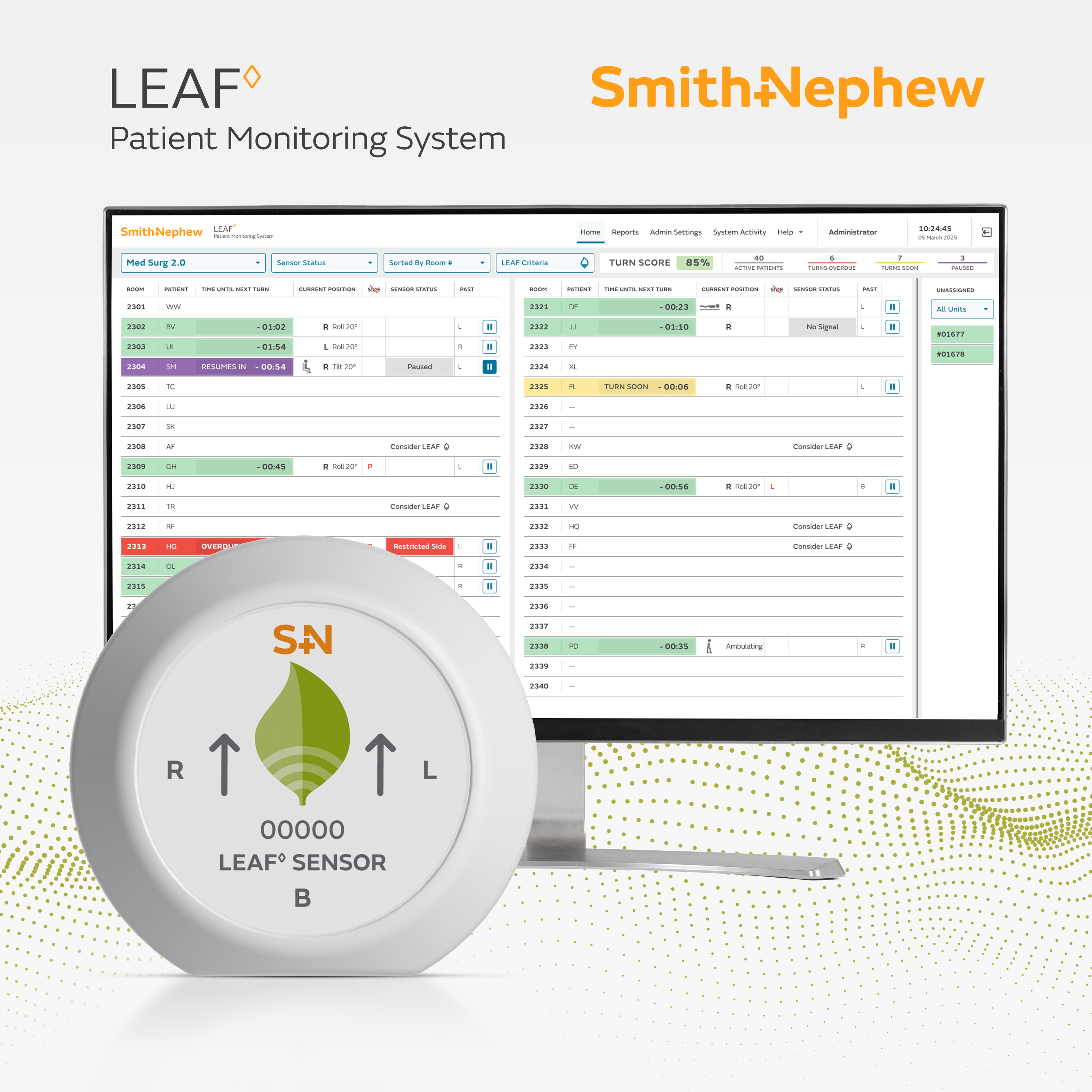
Positioned at the forefront of HAPI prevention, LEAF Next Generation is a cloud-hosted solution which features a redesigned and enhanced user interface. Designed in consultation with multidisciplinary nursing teams, LEAF Next Generation helps to ensure that at-risk patients get the necessary care at the appropriate time, with improved turn quality and protocol adherence.1-3 The system seamlessly integrates with hospital electronic medical records (EMRs), helping nurses to adhere to turning protocols using real time data and reporting that quickly identifies at-risk patients. Hosted securely on Smith+Nephew’s cloud, with access via any hospital-approved device, clinicians are able to focus on patient care rather than system maintenance.
The system's user interface enables intuitive workflow navigation with document automation which allows nurses to quickly access critical information and streamline patient management. Interdisciplinary teams benefit from instant access to patient-level insights, alongside a hospital-wide view to assess performance over time. This helps to ensure continuous delivery of high-quality care is maintained at all times.6
The LEAF system has already transformed HAPI prevention, turning evidence into action compared to the standard of care. Each year, it monitors over 150,000 patients,6 reducing the odds of HAPIs by up to 73%2 and delivering up to $1.8 million in estimated savings in just one critical care facility.7,8
Rohit Kashyap, President of Advanced Wound Management at Smith+Nephew said “The LEAF Patient Monitoring System has truly revolutionized how we think about pressure injury prevention. Scalability, interoperability, and ease of use are key to driving adoption and establishing a new standard of care in patient turning and repositioning. Backed by proven outcomes for both clinicians and patients, The LEAF System is already shaping what’s possible in pressure injury prevention protocols.“
The next generation of the LEAF Patient Monitoring System is now commercially available in the US as we support healthcare providers and patients in reducing the burden of HAPIs.
To learn more about LEAF Next Generation, please click Homepage | LEAF System
References:
- Larson B, Pihulic M, Luu N, Cooley A. Impact of turn compliance on probability of hospital-aquired pressure injuries: A multi-centre analysis. Poster presented at: The National Pressure Ulcer Advisory Panel Biennial Conference; March 10- March 11, 2017; New Orleans, Louisiana, USA.
- Pickham D, Berte N, Pihulic M, et al. Effect of a wearable patient sensor on care delivery for preventing pressure injuries in acutely ill adults: A pragmatic randomized clinical trial (LS-HAPI study). Int J Nurs Stud. 2018;80:12-19.
- Schutt SC, Tarver C, Pezzani M. Pilot study: Assessing the effect of continual position monitoring technology on compliance with patient turning protocols. Nurs Open. 2018;5(1):21-28.
- Agency for Healthcare Research and Quality website. Preventing pressure ulcers in hospitals: a toolkit for improving quality of care. https://www.ahrq.gov/professionals/systems/hospital/pressureulcertoolkit/putool1.html. Updated October 2014. Accessed February 1, 2018.
- Padula W V., & Delarmente, B. A. (2019). The national cost of hospital-acquired pressure injuries in the United States. Wound Repair and Regeneration, 27(3), 329–335 WV, Delarmente BA. The national cost of hospital-acquired pressure injuries in the United States. Int Wound J. 2019;16(3):634-640.
- Klaeb M, Krafft K, Walters B, Lowe J, Cooley A. The Influence of Wearable Technology on Nursing Attitudes and Adherence to Patient Turning and Repositioning. Poster presented at: Patient Handling and Mobility Annual Conference; March 5- March 7, 2019; Orlando, Florida, USA. Note: in intensive care units.
- Smith+Nephew 2020.Leveraging novel technology to decrease hospital-acquired pressure injuries. Internal Report. EO.AWM.PCS006.001.v1.
- Gasparini R, Derisma Q, Hannon R. “Turning” to Technology: Reducing Hospital Acquired Pressure Injuries in Critical Care with Visual Turn Cueing. Poster presented at: National Pressure Injury Advisory Pannel Annual Conference; March 10- March 12, 2021; Virtual Conference.
Enquiries
Frida Wilhelmsson +46 (738) 499 429
Smith+Nephew frida.wilhelmsson@smith-nephew.com
About Smith+Nephew
Smith+Nephew is a portfolio medical technology business focused on the repair, regeneration and replacement of soft and hard tissue. We exist to restore people’s bodies and their self-belief by using technology to take the limits off living. We call this purpose ‘Life Unlimited’. Our 17,000 employees deliver this mission every day, making a difference to patients’ lives through the excellence of our product portfolio, and the invention and application of new technologies across our three global business units of Orthopaedics, Sports Medicine & ENT and Advanced Wound Management.
Founded in Hull, UK, in 1856, we now operate in around 100 countries, and generated annual sales of $6.2 billion in 2025. Smith+Nephew is a constituent of the FTSE100 (LSE:SN, NYSE:SNN). The terms ‘Group’ and ‘Smith+Nephew’ are used to refer to Smith & Nephew plc and its consolidated subsidiaries, unless the context requires otherwise.
For more information about Smith+Nephew, please visit www.smith-nephew.com and follow us on X, LinkedIn, Instagram or Facebook.
Forward-looking Statements
This document may contain forward-looking statements that may or may not prove accurate. For example, statements regarding expected revenue growth and trading profit margins, market trends and our product pipeline are forward-looking statements. Phrases such as "aim", "plan", "intend", "anticipate", "well-placed", "believe", "estimate", "expect", "target", "consider" and similar expressions are generally intended to identify forward-looking statements. Forward-looking statements involve known and unknown risks, uncertainties and other important factors that could cause actual results to differ materially from what is expressed or implied by the statements. For Smith+Nephew, these factors include: conflicts in Europe and the Middle East, economic and financial conditions in the markets we serve, especially those affecting healthcare providers, payers and customers; price levels for established and innovative medical devices; developments in medical technology; regulatory approvals, reimbursement decisions or other government actions; product defects or recalls or other problems with quality management systems or failure to comply with related regulations; litigation relating to patent or other claims; legal and financial compliance risks and related investigative, remedial or enforcement actions; disruption to our supply chain or operations or those of our suppliers; competition for qualified personnel; strategic actions, including acquisitions and disposals, our success in performing due diligence, valuing and integrating acquired businesses; disruption that may result from transactions or other changes we make in our business plans or organisation to adapt to market developments; relationships with healthcare professionals; reliance on information technology and cybersecurity; disruptions due to natural disasters, weather and climate change related events; changes in customer and other stakeholder sustainability expectations; changes in taxation regulations; effects of foreign exchange volatility; and numerous other matters that affect us or our markets, including those of a political, economic, business, competitive or reputational nature. Please refer to the documents that Smith+Nephew has filed with the U.S. Securities and Exchange Commission under the U.S. Securities Exchange Act of 1934, as amended, including Smith+Nephew's most recent annual report on Form 20-F, which is available on the SEC’s website at www. sec.gov, for a discussion of certain of these factors. Any forward-looking statement is based on information available to Smith+Nephew as of the date of the statement. All written or oral forward-looking statements attributable to Smith+Nephew are qualified by this caution. Smith+Nephew does not undertake any obligation to update or revise any forward-looking statement to reflect any change in circumstances or in Smith+Nephew's expectations.
◊ Trademark of Smith+Nephew. Certain marks registered in US Patent and Trademark Office.


Legal Disclaimer:
EIN Presswire provides this news content "as is" without warranty of any kind. We do not accept any responsibility or liability for the accuracy, content, images, videos, licenses, completeness, legality, or reliability of the information contained in this article. If you have any complaints or copyright issues related to this article, kindly contact the author above.
